
Article Table of Contents
I. Introduction: Demystifying Sampling Costs for Informed Sourcing
II. The Strategic Business Case for Yarn Dyeing Sampling
III. Breaking Down the Sampling Cost Structure in China
IV. The 5 Key Factors That Determine Your Final Quote
V. Comparative Analysis: A Breakdown of Service Tiers and Costs
VI. Beyond Price: Navigating the Selection of Sampling Partners in China
VII. Ensuring Value: From Sampling to Production Consistency
VIII. Future Trends in Sampling Technology and Cost Implications
IX. Conclusion: Strategic Investment for Market Success
X. FAQ: Addressing Key Buyer Questions
Article
I. Introduction: Demystifying Sampling Costs for Informed Sourcing
For global procurement managers and product developers, the journey from a color concept to a bulk-produced yarn begins with a critical, yet often opaque, What are the costs for yarn dyeing sampling in China? step: dyeing sampling. This process, far from being a simple expense, is a foundational investment in product quality, supply chain efficiency, and market readiness. In China, the world’s foremost textile manufacturing hub, sampling costs are not a single flat fee but a spectrum influenced by a matrix of technical and service factors. This guide provides a comprehensive, data-driven analysis to equip you with the knowledge to budget accurately, negotiate effectively, and select the right partners, ensuring your sampling expenditure translates directly into commercial value and speed-to-market advantage.
II. The Strategic Business Case for Yarn Dyeing Sampling
Viewing sampling purely as a cost is a strategic misstep. It is a risk-mitigation and value-creation tool.
- Precision & Compliance: Sampling validates lab dips against your physical or digital color standards, ensuring the dyed yarn meets the specified hue, depth, and tone. It is the first practical check for meeting stringent international colorfastness and ecological standards (e.g., AATCC, ISO, OEKO-TEX® STANDARD 100), which are non-negotiable for major brands.
- Supply Chain Optimization: A perfect sample approved by your team becomes the undisputed reference for the dye house’s bulk production. This minimizes costly shade disagreements, production delays, and rejected batches downstream.
- Innovation Catalyst: Sampling is essential for testing new fiber blends (e.g., recycled polyester with cotton), experimenting with functional dyes, or achieving complex heather and melange effects that are calculated digitally but must be proven physically.
III. Breaking Down the Sampling Cost Structure in China
A typical sampling quote bundles several components. Understanding each helps in evaluating proposals.
- Base Sampling/Lab Dip Fee: This is the core fee to produce a small dyed yarn skein (typically 200g or less) to match your provided Pantone, textile, or physical standard. Base fees can start from as low as ¥100-500 (approx. $14-$70 USD) per initial color attempt for a standard formulation.
- Color Matching & Correction Rounds: The first lab dip is rarely perfect. Each subsequent correction to adjust the shade incurs an additional fee, usually a percentage (e.g., 50-70%) of the base sampling fee.
- Small-Lot Production Fee: Once a lab dip is approved, a “bulk sample” of a larger quantity (e.g., 1-5 kg) may be required for knitting/weaving trials. This involves small-scale production runs, costing significantly more than lab dips but far less than full production.
- Technical Development Fee: For projects requiring non-standard dyeing techniques, new chemical formulations, or specialized processes (e.g., for high-performance fibers, ultra-deep blacks, or bio-based materials), suppliers may charge a project-based technical development fee, ranging from ¥1,000 to over ¥5,000 ($140-$700+ USD).
- Testing and Certification Fees: Professional color measurement (using spectrophotometers), physical tests (strength, pilling), and comprehensive colorfastness testing (washing, rubbing, light, perspiration) are billed separately. Basic colorfastness tests can start around ¥100 ($14 USD) per test, while a full suite for a critical application can cost ¥1,000 ($140 USD) or more.
IV. The 5 Key Factors That Determine Your Final Quote

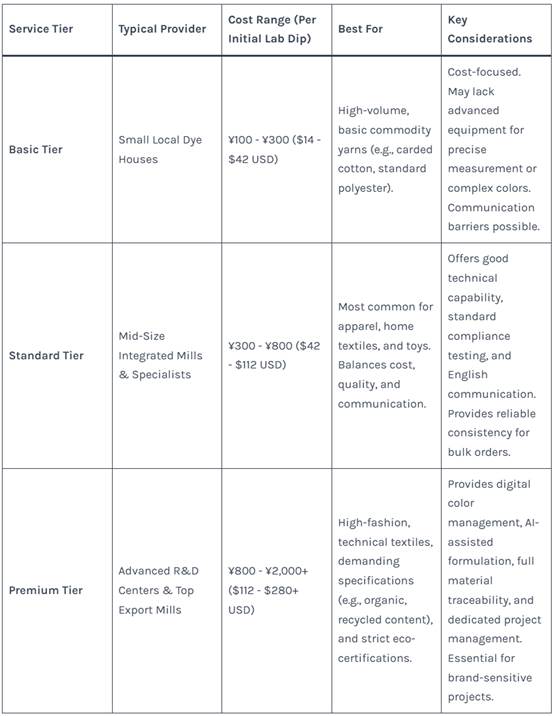
V. Comparative Analysis: A Breakdown of Service Tiers and Costs
The table below provides a realistic snapshot of the Chinese sampling market.
VI. Beyond Price: Navigating the Selection of Sampling Partners in China
Choosing based solely on the cheapest quote is a high-risk strategy. Evaluate partners on:
- Technical Capability: Do they have a certified lab with modern spectrophotometers and data management software? Can they provide a Color Difference (Delta-E) report with each submission?
- Communication & Transparency: Is there a clear, English-speaking technical contact? Do they proactively explain corrections and challenges?
- Scalability & Compliance: Can they demonstrate a clear pathway from sample to bulk production with consistent results? Are they audited for social and environmental compliance (e.g., STeP by OEKO-TEX®)?
VII. Ensuring Value: From Sampling to Production Consistency
To protect your investment:
- Provide Perfect Standards: Send a clean, stable physical standard or provide precise digital (RCI) data.
- Define Approval Parameters: Agree on an acceptable Delta-E tolerance (e.g., DE<1.0 under D65 light) and specify required colorfastness levels before sampling begins.
- Document Everything: Ensure the final approved sample is signed off by both parties and retained as the “gold standard” for production.
VIII. Future Trends in Sampling Technology and Cost Implications
- Digital Color Science: Adoption of AI-powered color matching is growing, potentially reducing correction rounds and speeding up the process, though it may carry a premium fee initially.
- Sustainability-Driven Costs: Sampling for fibers like recycled polyester, organic cotton, or bio-based materials often incurs a 15-30% premium due to specialized dyeing processes and certification requirements.
- On-Demand & Micro-Sampling: Some innovators offer ultra-small, rapid sampling (e.g., 50g) using automated systems, potentially lowering the cost of early-stage experimentation.
IX. Strategic Investment for Market Success
The cost of yarn dyeing sampling in China is a direct reflection of complexity, quality, and service depth. By understanding the cost structure and key influencing factors, procurement professionals can move from seeing sampling as a variable expense to managing it as a strategic investment. Allocating budget for a reputable, technically adept sampling partner is not an overhead cost—it is your first and most effective insurance policy against production failures, ensuring your final product meets the market’s exacting standards for color, quality, and sustainability.
X. FAQ: Addressing Key Buyer Questions
- What is a realistic total budget for developing one new yarn color?
Budget for ¥500-¥1,500 ($70-$210 USD) as a starting point for a standard fiber. This should cover 1-2 correction rounds and basic lab tests. Complex colors or fibers can easily double this. - Can I get accurate sampling done online without visiting China?
Yes, with a qualified partner. The key is providing a physically mailed color standard or impeccable digital color data (RCI file). Reputable suppliers use calibrated monitors and will mail physical dips for your approval. - Are sampling costs deducted from my future bulk order?
Typically, no. Sampling is a separate R&D service. However, many suppliers will waive or significantly reduce sampling fees for confirmed bulk orders above a certain volume threshold. This must be negotiated upfront. - What is the biggest hidden cost in the sampling process?
Time delays from poor communication and multiple correction rounds. Choosing a cheaper but less technically capable supplier often results in more rounds, slower turnaround, and delayed production—a cost far exceeding the initial sampling fee savings. - How do I ensure the sampled color matches in bulk production?
Insist that your supplier uses the exact same dye lot and chemical batch from the approved sample for the bulk production. The approved sample and its detailed formula must be physically stored and referenced at the production dye house. - What certifications should I ask for from a sampling lab?
For credibility, look for labs with CNAS (China) or ISO 17025 accreditation. If producing for eco-conscious markets, ensure the partner understands and can formulate dyes to meet OEKO-TEX® STANDARD 100 or bluesign® criteria. - How long does the sampling process usually take?
Allow 7-10 working days for the first lab dip submission, plus 3-5 working days for each correction round. Expedited services are often available at a 30-50% surcharge. - Should I sample with multiple suppliers simultaneously?
This “trialing” strategy is common but has pros and cons. It can provide cost/quality comparisons but may burn supplier goodwill. It’s more effective for high-value, long-term projects after an initial pre-qualification stage.