

Australia is a representative trader because of the integrity of its trading economy, supported by abundant natural resources, an advanced services sector, and strong agricultural production. International trade has continuously maintained the resourcing of rich Australian industries with major consumer and manufacturing markets across Asia, North America, and Europe. Australia customs data reported that the total goods exported, along with the combination of services, has reached a valuation of 665.2 billion US dollars in 2025, with an increase of 3.1% from the previous year.
The imports of goods and services have reported a valuation of 42.6 billion US dollars, which is approximately 6.9% of the overall trade. Merchandise exports have been strongly supported by iron ore, coal, natural gas, gold, agricultural commodities, and the travel services trade. The import market is dependent on machinery, electric vehicles, refined petroleum, industrial equipment, and pharmaceuticals. Australia Import Data have been valuable for businesses because of the identification of buyers, suppliers, distributors, manufacturers, and emerging trade opportunities.
THE SIGNIFICANT ROLE OF AUSTRALIA IN THE GLOBAL MARKETPLACE
Australia trade data reported the country as one of the crucial role players in the global marketplace because of the economic relationship with major Asian economies. The leading supply of minerals, energy products, agricultural commodities, and educational services has supported the maintenance of trade. China is one of the largest export destinations because of the trading integrity in 2025. Australia’s export of goods and services has represented 29% of its overall trade with China.
The total goods and services trade between Australia and China is 25% of the total trade of the country. Japan, with its effective resourcing of coal, natural gas, iron ore, beef, and copper, has maintained bilateral integrity with Australia. The United States is also a top trade partner, with a valuation of 33.7 billion US dollars of trade in 2025. The South Korean authorities have recorded exports of essentials of 67.5 billion US dollars, basically supported by commodities including iron ore, coal, natural gas, and beef. The diversity in international trade has been creating opportunities for Australian exporters and international suppliers across resources.
THE COMPREHENSIVE OVERVIEW OF AUSTRALIA IMPORTS
Australia customs data listed domestic consumption, infrastructure development, industrial production, and technology adoption as the main factors supporting the overall trade integrity. The reliance of the country on international suppliers for many manufactured essentials has competitively supported the domestic manufacturing base. Machinery, electric equipment, vehicles, refined petroleum, and telecommunications have maintained important components of trade. The Australia Shipment data has provided visibility into merchandise imports and exports.
The Australian merchandise trade accounts for a massive trade share. The Department of Home Affairs, along with the adjustments made by the ABS, has supported the classification, coverage, and timing of the trade when required. Machinery, electrical machinery, passenger motor vehicles, refined petroleum, computers, and telecommunications are some of the latest variants of goods imported. Australia import data lists China, the United States, South Korea, and Singapore as the major import partners supporting the overall trade integrity. The international suppliers help the authorities identify the products experiencing consistent demand rates.
EXPORT MARKET OVERVIEW OF AUSTRALIA
Australia Export Data reports that the heavy influence of the country by natural resources, energy, agriculture, and services is mainly because of the top exports of goods demanded worldwide. Iron ore and concentrates, coal, natural gas, education-related travel services, gold, and personal travel services are the latest exports from the nation.
Iron ore has been the largest exported variant of the nation. Coal accounts for 11% of Australia’s traded exports. Gold trade is increasing due to the global consumer demand rate hike. The export structure is mainly shaped by the combination of natural resources along with agriculture, education, and tourism.
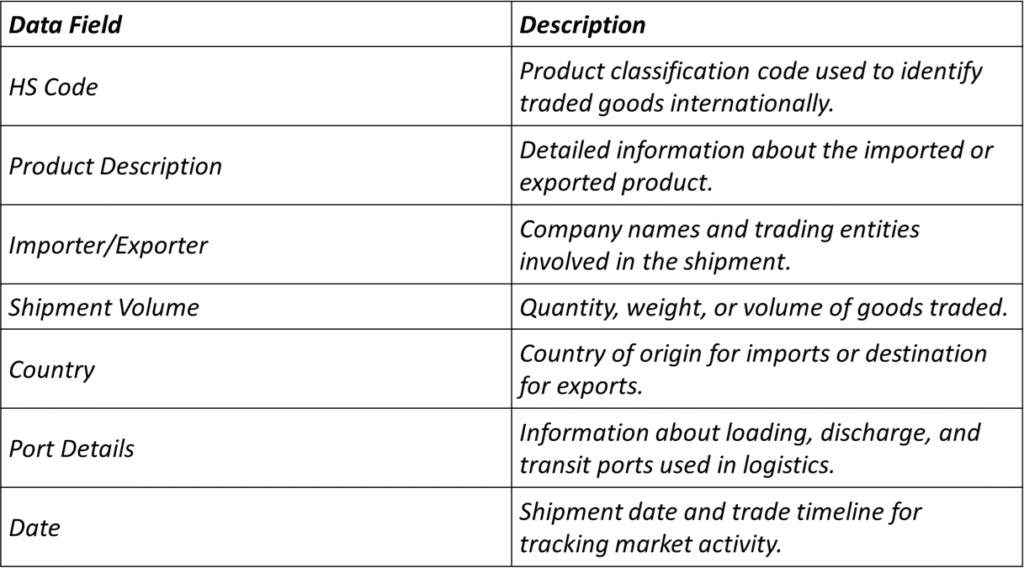
WHAT DETAILS ARE INCLUDED IN AUSTRALIA CUSTOMS DATA?
THE EFFECTIVENESS OF AUSTRALIA IMPORT-EXPORT DATA PROVIDERS IN BUSINESS GROWTH
Australia import-export data providers have been a valuable tool for business authorities because they help businesses craft their marketing strategies with acknowledgement of the official statistics. The detailed commercial shipment data helps progressive traders with additional information about companies, products, suppliers, buyers, and shipment activity.
Businesses can gain entry into the Australian markets with the proper use of the information containing details on established importers, distributors, wholesalers, and manufacturers. The shipment frequency analysis helps companies distinguish between shipment frequencies, sourcing countries, suppliers, and products for understanding the competing companies on a worldwide scale.
HOW DOES AUSTRALIA IMPORT-EXPORT TRADE DATA SUPPORT BUSINESS GROWTH?
- Identification of global buyers and suppliers – Australia trade data gives the proper classification to the business authorities regarding active importers, exporters, distributors, and manufacturers. The companies can examine purchasing activity to identify the organizations with a consistent demand rate.
- Analysis of competitor activities – The Australia import data supports the acknowledgement of competitive intelligence with understanding of supplier products and international purchasing relationships. The companies can compare the sourcing strategies for identification of alternative suppliers.
- Education and evaluation regarding market demand trends – The proper acknowledgement of the market demand trends gives a clear visualization to the businesses regarding historical Australia shipment data. It helps businesses monitor changes and predict demand, along with identification of the seasonal purchasing patterns.
- Supply chain optimization – Australia customs data helps businesses examine sourcing countries. The information supports alternative sourcing decisions and helps companies build resilient international supply chains.
FUTURE TRADE OUTLOOK OF AUSTRALIA TRADE DATA
Australia trade data has been a valuable resource for classification and projected growth in different sectors. Technological investment, agricultural production, services, and exports have supported supply chain diversification. Iron ore, natural gas, coal, gold, agricultural commodities, and education services have shaped export performance. The increasing investment in renewable energy, critical minerals, and electric mobility has created new trade opportunities.
The strong economic relationships maintained by the country with China, Japan, South Korea, and India have promoted the future direction of international trade. The digital customs systems, automated documentation, and advanced analytics have maintained the increasing importance of the specific role in managing changing trade conditions.
Conclusion
The Australian authorities have strengthened the position of the country as a reliable trader supported by the resource-rich export base. Goods and services exports have recorded a valuation of 665.2 billion US dollars in 2025. Iron ore, coal, natural gas, gold, education-related travel, beef, and aluminum ores are some of the latest variants implemented by the authorities for regularized movements. The importance of Australia Export Data is that it helps businesses seek accurate and actionable market intelligence.
CTA
Looking for an expansion in your business in Australia’s trade memorandum? You have landed at the right platform here. Import Globals holds a specialization in providing detailed information regarding distributors and competitors. Subscribe to www.importglobals.com or drop an email at info@importglobals.com for detailed updates on Australian trade activities to drive your business growth.
FAQs
Que-Why is Australia export data beneficial for business growth?
Ans -Australia export data is beneficial for business growth because it supports competitor research and market expansion.
Que-What is the global export trade rank of Australia in 2025?
Ans –The global export trade rank of Australia in 2025 is 19th.
Que-How does Australia import export data support business growth?
Ans -Australia import export data supports business growth via proper identification of buyers, supplier analysis of market demand, and development of effective market expansion strategies.
Que-What information is available in Australia trade data?
Ans -Australia trade data covers Importer names, Exporter names, Shipment date, HS Code, Product Details, quantity, values, pricing information, origin country, importing country & port details.
Que-How frequently is Australia trade data updated?
Ans -Australia trade data is updated on a monthly basis.
Que-Where can I get detailed information on Australia trade data?
Ans –Visit www.importglobals.com or drop an email at info@importglobals.com for detailed information on Australia trade data.