
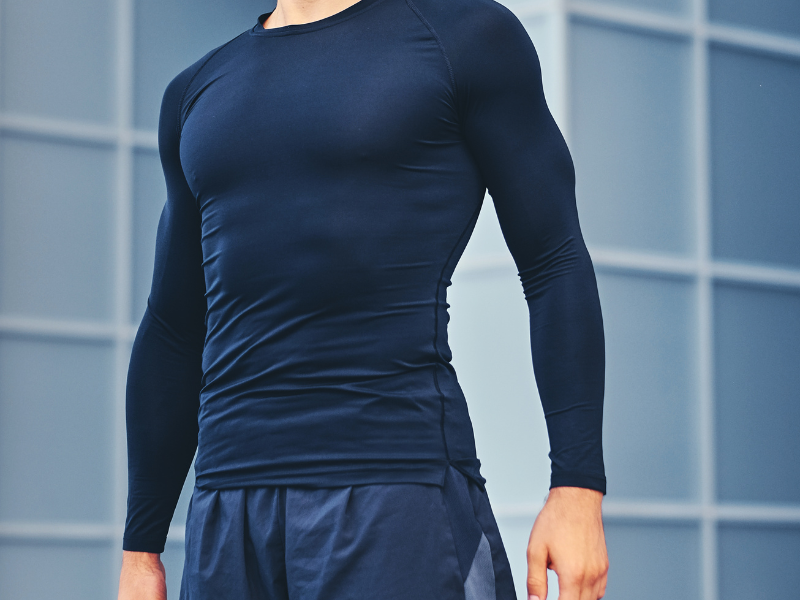
You’ve switched to reef-safe sunscreen. You rinse before entering the water. You advocate for coral protection in the dive community. You also train in polyester shorts and a synthetic rash guard.
That combination sends microplastics directly onto reef systems every time you enter the ocean.
What Reef Conservation Is Missing
The reef-safe sunscreen movement has correctly identified oxybenzone and octinoxate as chemical threats to coral. Awareness has driven legislation and real market change. The messaging has worked.
But the same conversation rarely mentions synthetic activewear. Every time you enter the ocean wearing polyester or nylon workout clothing, you shed microplastic fibers directly into the marine environment. These fibers don’t disperse into open water. They accumulate on reef systems, where they create physical and chemical damage.
Physically, microplastic fibers tangle in coral tissue and block light penetration. Chemically, they carry absorbed pollutants — pesticides, heavy metals, hormone disruptors — that synthetic fabric accumulates during normal washing and wear. The reef receives both the plastic and whatever the plastic brought with it.
A single synthetic garment sheds thousands of microfibers per swim. A group of water athletes in polyester workout clothing produces a microplastic event that outweighs what their sunscreen choice would have contributed.
You can’t protect the reef at the surface level while introducing plastics into it from a different angle.
What to Look for in Ocean-Responsible Workout Clothing
Natural Fiber Construction
The only complete solution to synthetic microplastic contribution is wearing clothing that doesn’t contain synthetic polymers. Natural fiber workout clothing — organic cotton, wool, hemp — sheds no synthetic microplastics because none are present in the material.
GOTS Certification for Chemical Safety
Natural fiber garments produced with conventional chemical inputs can still contribute harmful chemical runoff to ocean water. GOTS-certified organic underwear mens and workout clothing is produced without the synthetic pesticides and chemical finishes that end up in wastewater and ultimately in coastal waters.
Performance Verification
A common concern is that natural fiber workout clothing won’t perform in water-based training environments. The relevant metrics are moisture management during exercise on land and thermal neutrality. For swimming specifically, the comparison doesn’t apply — you’d wear a wetsuit or swimwear. For land-based ocean training and transition moments, organic cotton performs.
Durability for Saltwater and Sun Exposure
Coastal training environments are harder on clothing than indoor gyms. Salt, UV, and sand all accelerate fabric degradation. Look for tightly woven organic cotton construction that maintains structural integrity in these conditions.
Supply Chain Environmental Impact
The environmental impact of your workout clothing extends beyond what happens when you wear it. Conventional cotton farming uses significant pesticide volumes that reach coastal waterways. GOTS-certified organic cotton from verified origins uses farming methods that don’t introduce these chemicals into the agricultural watershed.
Practical Habits for the Ocean-Conscious Athlete
Wear natural fiber clothing for all non-swimming ocean training. Beach runs, outdoor workouts near coastal environments, and post-surf casual time are all opportunities to eliminate synthetic microplastic contribution from clothing.
Rinse natural fiber garments in fresh water post-ocean use. This removes salt that can degrade fiber quality over time, extending the garment’s life and reducing replacement frequency.
Pair reef-safe sunscreen with natural fiber clothing. The two interventions target different chemical threats to reef systems. Doing both closes the loop on personal contribution to reef chemical exposure.
Advocate within your dive or surf community. The sunscreen conversation succeeded because divers and surfers talked about it. The synthetic clothing conversation needs the same community-level momentum. Organic underwear mens and natural fiber activewear brands deserve the same word-of-mouth that reef-safe sunscreen got.
Consider the full training session, not just the water entry. Most ocean athletes spend more time training on land near the coast than in the water. The clothing worn during that land training sheds microplastics that reach the ocean through runoff and wind.
Why This Is the Next Reef Conservation Conversation
Coral reef coverage has declined significantly over the past several decades. Multiple threat vectors — warming, acidification, chemical pollution, physical damage — are operating simultaneously. Each one that humans can influence through individual choice is worth addressing.
Reef-safe sunscreen was the first mainstream conversation about personal contribution to reef chemical health. Synthetic workout clothing is the next one.
The intervention is the same model: identify a product category that delivers known reef toxicants, offer an alternative that doesn’t, and build community awareness around the swap. Natural fiber workout clothing is that alternative for synthetic microplastics.
The reef doesn’t need perfect behavior from every athlete. It needs meaningful reduction from the communities that care most about it. Ocean athletes are that community. The next move is already clear.